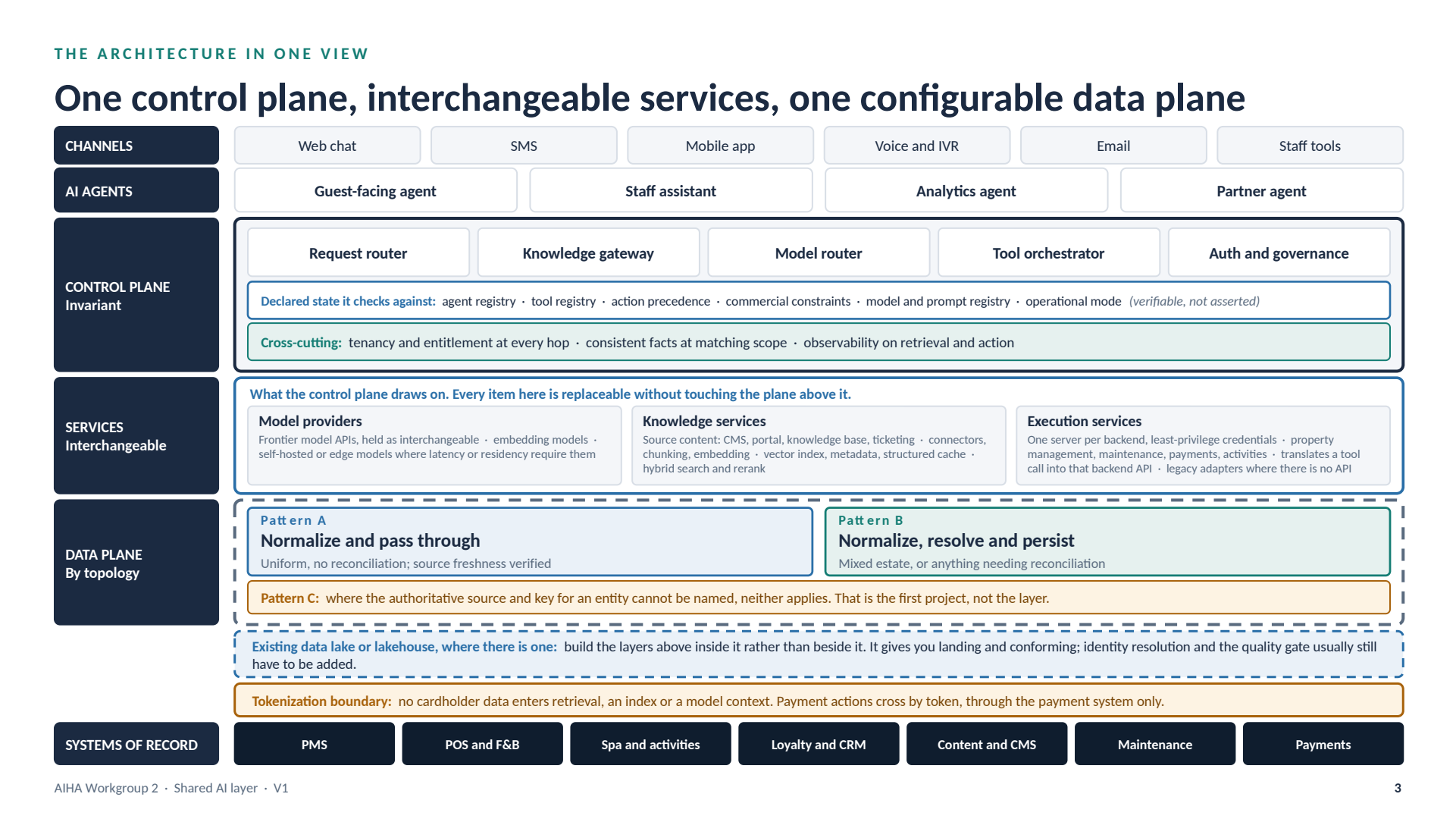
Use a shared integration and control layer when several agents or channels need the same hotel facts or actions. It reduces repeated interfaces, prevents each agent from inventing its own retrieval logic, and localizes provider changes. If everything stays inside one system and one vendor, defer a separate layer unless the evidence shows a need.
The architecture in one view. One logical control plane sits above interchangeable services and a data-plane configuration chosen for the estate. Open full size ↗
Choose the right data foundation
Uniform products and no reconciliation need can use normalize-and-pass-through. Mixed systems, cross-system identity reconciliation or batch-only sources may need a governed persistent foundation. Missing authoritative records are a stop signal.
Keep authority outside the model
Agents propose. Deterministic services validate scope, permissions, precedence, commercial constraints and operating mode before writes. Systems of record retain the authoritative facts.
Name who runs it
Assign one accountable owner, incident and after-hours cover, an explicit allowlist, a documented exit path and access to evidence across vendors.
Ask for demonstrations
Use the integration workbook, 14 procurement questions and 30 technical self-assessment checks. Record unknowns and gaps. None of these tools is a vendor score or proof of complete safety.